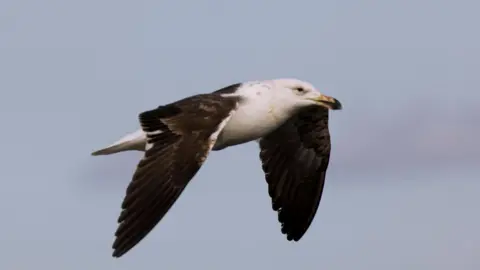
On a small boat in the Atlantic, about 27 nautical miles away from South Africa's Cape Point, a group of bird watchers is excitedly identifying seabirds like the Black-browed Albatross. These tours help enthusiasts spot endangered seabirds that are increasingly difficult to find on the mainland.
The bird watchers travel with Cape Town Pelagics, a non-profit organization dedicated to observing seabirds. On this clear, summer day, their skipper is on the lookout for fishing trawlers, which attract numerous seabirds.
Upon locating a fishing vessel, the boat moves closer, and hundreds of birds gather, hoping for a meal from the fish scraps the crew discards. Unfortunately, this scavenging behavior puts the birds at risk as they can become entangled in fishing lines.
Tim Appleton, a conservationist, explains that seabirds often get caught on long fishing lines used to catch large fish, such as tuna. These lines can stretch as far as 100 kilometers and contain thousands of baited hooks, which can lead to accidental drownings.
Albatrosses, spending much of their lives at sea, face significant dangers from fishing boats. Their population is declining due to bycatch—a term that describes the accidental capture of non-target species.
Andrea Angel from BirdLife South Africa emphasizes that albatrosses are particularly at risk, with 15 of the 22 global species threatened by fishing. The challenge is compounded by the albatross mating habits; they mate for life and only have one egg every two years, making their population recovery slow.
To mitigate these risks, BirdLife South Africa has been working on innovative solutions, including the implementation of bird-scaring lines, which act like scarecrows to keep birds away from fishing nets. Colorful streamers suspended above the nets create a visual deterrent, preventing birds from getting ensnared.
Interestingly, BirdLife collaborates with the Ocean View Association for Persons with Disabilities, allowing disabled workers to participate in creating these bird-scaring devices. This partnership not only promotes conservation but also provides an economic benefit to a community that has faced hardships.
Despite the many advantages, many fishermen still overlook the use of bird-scaring lines, citing time constraints and safety concerns. Yet Andrea points out that these lines are crucial; a big tuna, worth $10,000, is significantly more profitable than a bird, which holds no monetary value.
Since the establishment of the Albatross Task Force in 2004, there has been a remarkable 90% reduction in albatross deaths due to Southern African fisheries, a success they wish to replicate globally. These efforts are vital to ensure the albatross can continue to thrive for generations to come.