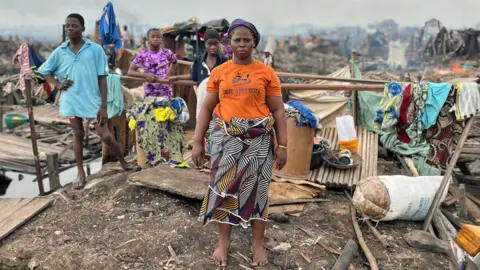
A mother of five, Anna Sobie's wooden home is one of many that has been demolished in a shanty town in a lagoon in Lagos, with critics describing it as a land-grab by the authorities to gentrify the prime waterfront spot in Nigeria's biggest city.
Lagos State government officials deny the allegation, saying they are demolishing parts of Makoko - the country's biggest informal waterfront settlement - because it is expanding near high voltage power lines, posing a major health and safety risk.
Sobie and her children now sleep on the narrow broken platform where their house stood until a few weeks ago on Lagos Lagoon. This is the biggest of 10 lagoons in a mega-city that is facing an acute housing crisis - and where life is becoming increasingly expensive, pushing more people to the margins of society.
As Sobie spoke to the BBC, canoes - steered with paddles or long bamboo poles - moved through the narrow waterways, carrying mattresses and sacks of clothes belonging to the displaced people.
Residents say the demolitions began two days before Christmas, when excavation teams accompanied by armed police moved into sections of the waterfront settlement facing the Atlantic Ocean.
In a joint statement last month, 10 non-governmental organisations said that armed thugs, security personnel and demolition teams with bulldozers descended repeatedly on the community to tear down homes, and burn them.
Homes were set on fire with little or no notice, in some cases while residents were still [inside], the NGOs added.
When the BBC visited Makoko, smoke, from the rubble of torched homes or from fires that people had lit, burning damp wood to dry their clothes, was hanging in the air.
Excavators were at work along the shoreline - houses built on wooden stilts over the lagoon were still being pulled down, their planks collapsing into the water below. Corrugated metal sheets were falling from roofs and drifting between boats.
Makoko was founded in the 19th Century by fishing communities who have lived in the settlement ever since, along with other low-income families and migrants who come to Lagos in search of better opportunities.
Ownership of the lagoon is fiercely contested. The state government claims ownership of it under federal law, saying Makoko has been built without planning permission or occupancy rights.
Older residents dispute this, saying the settlement predates modern Lagos, and they have what they call a customary right to it.
Estimates of Makoko's population vary, from 80,000 to 200,000, but much of the settlement now lies in fragments.
The NGOs said that more than 10,000 people have been displaced after the destruction of more than 3,000 homes, as well as schools, clinics and churches. The state government has not given any figures of the buildings demolished.
Sobie's home was among those that have been destroyed.
I was inside when it started, she says. The noise was very loud. When we came out, we saw the excavator.
She says there was little time to move her family's belongings. Her son Solomon's school in Makoko was demolished the same day. Sobie's family moved briefly into a building nearby. That, too, was later pulled down.
We're sleeping in an open space under the rain, and they're currently setting properties ablaze, Sobie says, adding: We don't have another place.
Like many other children, Solomon no longer goes to school. He now helps his mother gather firewood from collapsed houses, pulling loose planks from the debris to sell.
Even as the excavators work, canoe-borne business activities continue, with traders peddling their way between the remaining homes to sell fish and goods. But many other traders can no longer do business, as they lost their goods when their homes were demolished or torched.
With the lagoon central to their lives, they have protested against the move to force them out of Makoko.
More than 1,000 angry residents marched last week to the state legislature, the House of Assembly, demanding an audience with Governor Babajide Sanwo-Olu, whose offices are nearby. But police responded by firing tear gas, with protesters saying that at least one person was injured in the ensuing chaos.
Community leaders and residents say that tear gas was also fired during the demolitions a few weeks ago, causing the death of five people, including children. Sobie tells the BBC: Children were weeping, some died, some were unconscious, and were taken to the hospital as a result of the tear gas.
The Lagos State government says it is unaware of their personnel using tear gas or of deaths linked to the demolitions. Speaking to the BBC, the state's commissioner for information, Gbenga Omotoso, says that any such claims would be investigated.
He raised concern that shanties were sprawling at an incredible speed, getting closer to the Third Mainland Bridge, the longest and busiest of three bridges connecting the mainland to the islands. For the governor this spells danger.
Governor Sanwo-Olu said that affected families would be provided with financial grants and other assistance, and it was wrong to accuse him of destroying Makoko. He added: There are high-tension power lines right underneath there. I am not going to sit down, and something will drop off, and in one day, over 100 to 500 people will die.
He said, What we have done is that we just pushed them back. Meanwhile, Lagos-based real estate developer Peacemaker Afolabi tells the BBC that demand for land in the city is huge: Everywhere in Lagos is prime land. And waterfront is always prime. Some residents suspect that the demolitions are aimed at clearing the area for private developments, including luxury homes.
This has been repeatedly denied by the state government, but suspicion remains. In a statement by the NGOs, they argue that demolitions in Makoko, and other settlements last year, were part of a sinister agenda to grab land.
These actions against thousands of peaceful, hardworking residents represent a deliberate pattern of state-enabled violence against the urban poor, carried out to clear valuable land for elite interests and private mega-developments,” the NGOs said.
An official report released last year showed that while the city's housing supply improved significantly from 1.4 million units in 2016 to over 2.57 million units in 2025, it has not kept pace with demand". The housing deficit has thus grown from approximately 2.95 million units in 2016 to 3.4 million in 2025, a 15 per cent increase.
Despite the state government's claims of addressing housing issues, the actual situation depicted by residents of Makoko shows a stark contrast and raises questions about the future of housing rights in Nigeria's rapidly urbanizing environment.