
In brief
David Hockney, one of Britain’s most celebrated painters, passed away peacefully at home on 11 June 2026, one month shy of his 89th birthday. Former Prime Minister Sir Keir Starmer, culture icons Tracey Emin and Tracey Brabin, and art institutions such as the Tate Britain and Pompidou Centre publicly paid tribute, highlighting his bold use of colour and avant‑garde vision. Hockney’s body of work – from Yorkshire landscapes to Californian pool scenes – has influenced generations, and his legacy will be celebrated through two new Tate exhibitions. His generosity extended beyond art, donating to LGBTQ+ charities, while his personal life reflected his open queer identity. The art world mourns the loss of a true giant whose relentless curiosity reshaped contemporary painting.
On 11 June 2026, David Hockney, the celebrated British painter, died peacefully at home, a month before turning 89. The news triggered an outpouring of admiration from politicians, artists and cultural institutions alike.
National condolences
Prime Minister Sir Keir Starmer said he was "saddened" to hear of Hockney's passing and called him "one of Britain's most celebrated artists". A Downing Street spokesperson reinforced that Hockney’s "vivid, instantly recognisable work influenced generations".
London Mayor Sadiq Khan described Hockney as "a true icon and revolutionary of British art, who never stopped reinventing his work" and praised his paintings of nature for inspiring conservation.
Creative community pays tribute
Contemporary artist Tracey Emin wrote: "A great artist and a wonderful man, who with the power of art changed the perception of Britishness. A proud chain‑smoking homosexual, who flew the flag higher than any other British artist."
Queer UK‑Art network co‑leader Dominic James Bilton noted Hockney "pioneered queer British art before it was fashionable", highlighting his donation of a $250,000 painting to Stonewall's inaugural fund.
Tate Britain director Alex Farquharson hailed Hockney as "an immensely important figure, an endlessly inventive artist". He said the artist "been courageous in life and art, teaching us to see unnoticed joys".
International recognition
The Pompidou Centre called Hockney "unquestionably one of the major figures of contemporary art" and praised his work as "dazzling, alive and eternal".
Legacy and forthcoming exhibitions
The Tate will stage two projects next year: a seven‑decade retrospective at Tate Britain, and a multimedia installation in Tate Modern’s Turbine Hall that revives Hockney’s opera set designs.
His last major exhibition, a 2017 tour at Tate Britain, remains the museum’s most visited. The 2025 exhibition will continue to showcase his colourful spectrum of landscapes from Yorkshire and the Grand Canyon to his celebrated Californian swimming‑pool series.
Personal life and influence
Hockney moved to Los Angeles in 1964, producing iconic pool scenes. He later returned to the UK, painting yearly portraits using iPads, notably a spring collection produced during the COVID‑19 lockdown.
His early training at Bradford School of Art and the Royal College of Art (gold‑medal distinction) shaped his mastery of colour and technology. Colleagues recall his boundless curiosity and his embracing of new tools, from canvases to digital media.
Hockney leaves a hopeful legacy of curiosity, generosity, and an affirmation that art can shift cultural perceptions. He is survived by partner Jean‑Pierre Gonçalves de Lima, his great‑nephew assistant Richard, and a wide family network.
Images
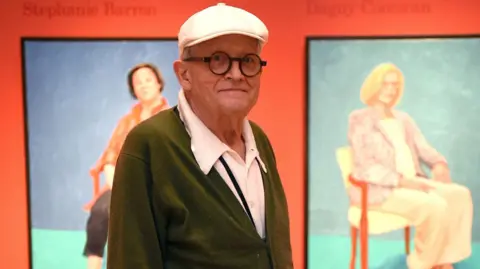
Photograph of Hockney in front of his groundbreaking painting “A Closer Grand Canyon” (1998) – Reuters