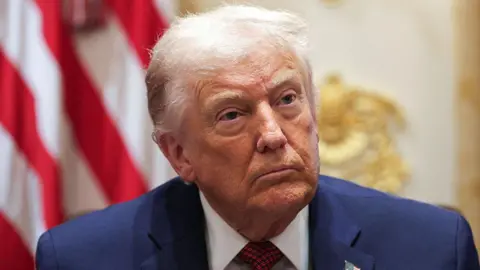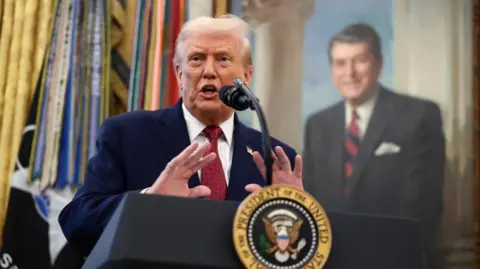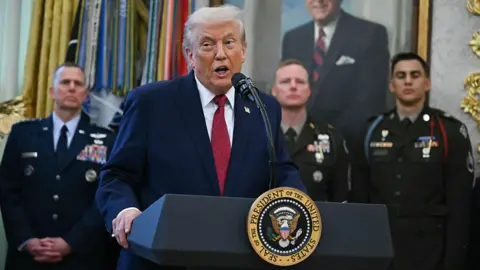
US President Donald Trump has announced a 'warrior dividend' payment to US service members, in a speech in which he also defended his track record on the economy after 11 months back in office.
In a televised address to the nation on Wednesday, Trump said cheques for $1,776 (£1,329) for 1.45 million US service members were already on the way and should arrive before Christmas. He said they would be paid for, in part, by his tariffs.
In the combative address, Trump also touted his achievements on immigration while railing against opposition Democrats.
Speaking loudly and quickly, he seemed determined to convince Americans that the US was doing well - and things would only get better.
He claimed prices were falling, at a time when polls show that many Americans are unhappy about the cost of housing, childcare and healthcare.
Democrats were critical of the speech. Senate Minority Leader Chuck Schumer said the president's words showed he lives in a bubble completely disconnected from the reality everyday Americans are seeing and feeling.
In the brief, 18-minute address, Trump said the warrior dividend, which totals $2.57bn (£1.9bn), would be distributed in honour of our nation's founding in 1776.
Trump added that the funds were drawn from his sweeping tariffs, as well as the One Big, Beautiful Bill that he signed into law on July 4.
Nobody deserves it more than our military, he said.
The president offered little new information in the speech, and some of his assertions were either exaggerated or unfounded.
Much of Trump's address focused on his economic record and the administration's efforts to bring down prices - which he blamed on former US President Joe Biden and the Democrats. Trump mentioned the former president seven times.
Now, under our leadership, they [prices] are all coming down and coming down fast, he said. Democrat politicians also sent the cost of groceries soaring, but we are solving that too.
While fuel and egg prices have indeed fallen, many other food items are more expensive.
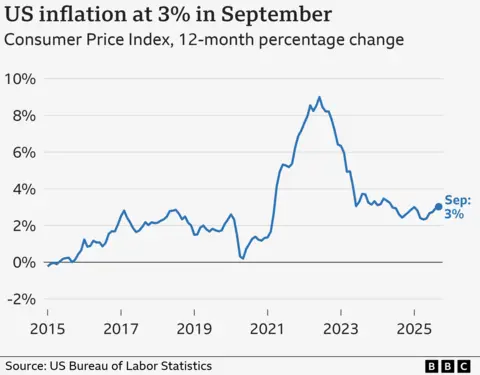
Economic data from September shows the US inflation rate hit 3% for the first time since January, while consumer confidence fell to its lowest level since April due to concerns over the cost of living, jobs, and the wider economy.
Trump has previously acknowledged that concerns over rising prices have contributed to a lacklustre performance for candidates from his Republican Party during elections held in November.
He has also acknowledged that incumbent presidents and their parties often fare poorly in mid-term elections, which will take place next year.
The White House has been wrestling with how to address voter concerns about the economy while pushing back on repeated Democratic criticism over rising prices.
The political dilemma faced by the Trump administration has been highlighted by recent polling, showing that about half of voters feel the cost of living is the worst it has been in their lives.
Trump's approval on economic issues has dropped, and broader polling suggests he is near the lowest approval ratings of his second term.
Despite the challenges, Trump touted Republican efforts like tax reform as a source of future benefits for Americans.
He stated, When the world looks at us next year, let them see a nation that is loyal to its citizens, faithful to its workers, confident in its identity, certain of its destiny, and the envy of the entire globe.
He concluded, We are respected again, like we have never been respected before.